
Europe retained the Solheim Cup at Bernardus Golf in Cromvoirt in September, winning by 15 points to 13 after three days of tense, absorbing match play in the Netherlands. Anna Nordqvist’s side held off an American team captained by Angela Stanford, with Linn Grant winning all four of her matches and Charley Hull making her seventh appearance in the event. Nelly Korda contributed two and a half points for the visitors, and the contest stayed close almost to the end.
Beyond the golf itself, team events like the Solheim Cup have a visual identity that individual tournaments lack. Each side appears in coordinated colours day by day, and the effect is striking on television and in person. Spectators can tell at a glance which way the session is going simply by scanning the colours on the scoreboard, and the players look like a unit rather than a collection of individuals.
That sense of belonging is not reserved for international teams. Club golf in the UK is full of team formats, from inter-club league matches and scratch teams to society days, charity events and seniors’ fixtures. The question of how a group of golfers should dress together comes up more often than many people expect, and the professional game offers some useful pointers for captains and organisers at every level.
Why coordinated colours work
The appeal of a team uniform goes deeper than appearance. Wearing the same colour as teammates builds a quiet sense of identity, which can matter on a tense afternoon when a match comes down to the final green. It also helps on the course itself, as partners can spot one another across fairways, captains can keep track of the matches out on the course and supporters at club level know who to cheer for.
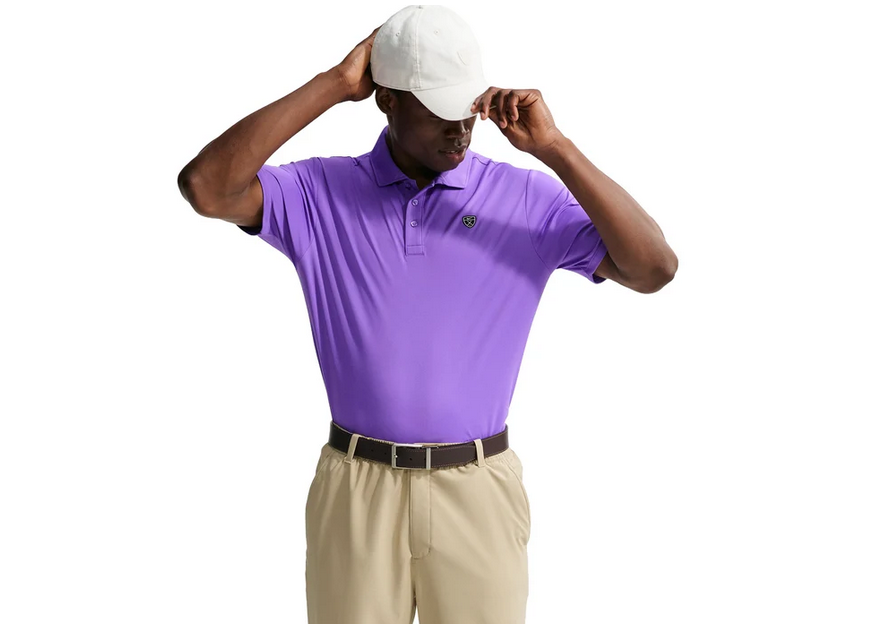
For a club team, the simplest starting point is a shared colour for each day of a fixture. Navy on the first day and white on the second, for instance, is easy to coordinate and flatters most people. The key is choosing tones that every member of the team will feel comfortable in, rather than a bold shade that only suits a few. Function18 stocks golf polo shirts in a wide range of colours from several brands, which makes it possible for a team to agree on a shade while each player picks a fit and fabric that suits them.
There is a psychological element too. Teams that look alike often feel more connected, and opponents notice when a side arrives looking organised and prepared. At club level, that matters less for intimidation than for the shared feeling of being part of something, especially for newer members who may be playing in their first team fixture and want to feel welcome.
Uniformity without identical kit
Not every club team wants, or can justify, matching kit from a single manufacturer. A strong team look can be achieved through colour alone. Six players in different polo shirts of the same navy, with trousers in a shared neutral such as grey or stone, will look coordinated from twenty yards away. The detail varies, but the overall impression is of a group that belongs together.
This approach also respects the reality that golfers come in all shapes and sizes and have their own preferences for fit. Some prefer a slimmer, athletic cut, while others want something more relaxed. Brands such as Ralph Lauren, Peter Millar, Nike and adidas each interpret the classic golf polo slightly differently, and all are available through Function18. Agreeing on colour first and leaving the choice of brand to the individual is often the most practical route for a society or club side, and it avoids the awkwardness of asking everyone to buy the same garment regardless of how it fits.
Layering as a team in autumn
The Solheim Cup is played as summer gives way to autumn, but most club team fixtures in the UK continue well into the colder months, when a single polo shirt is rarely enough. This is where team coordination tends to fall apart, as players arrive in a jumble of jackets and jumpers that hide the agreed colour completely.
One solution is to extend the colour scheme to the next layer. A team that agrees on navy polos might also agree on grey or navy over the top, so the look survives once the temperature drops. Function18 has an extensive choice of golf mid-layers, including quarter-zips and lightweight pullovers that sit neatly over a polo without adding bulk. Sleeveless options are equally useful, and gilets for golf keep the core warm while leaving the arms free, which many players prefer when swinging in cooler weather. A gilet in a team colour can also become the signature piece for a society, worn over whatever each player chooses underneath.
Headwear and the finishing touches
Hats and caps are perhaps the easiest way to unify a group. They are relatively inexpensive, visible from a distance and suit almost everyone. A society that cannot agree on shirts can often agree on a cap or beanie in a single colour, and the effect on a team photograph is surprisingly strong. The selection of caps and beanies at Function18 covers everything from lightweight peaked caps for warmer days to knitted styles for winter fixtures.
Other small touches add to the impression of a unit, such as matching towels on the bags, a shared colour of glove or even coordinated belts. None of these is essential, and the best club teams wear them lightly. The point is not to look like a corporate outing but to give players a modest sense of being part of something larger than their own scorecard.
Read More: Why Hiring a Private Chef Is Becoming More Popular
Headwear also solves a practical problem in mixed groups. A society day might include golfers of very different ages and styles, and a cap or bobble hat in a shared colour sits comfortably with almost any outfit. It is the kind of item that players are happy to keep wearing long after the event, which gives a society a lasting, low-key identity on the course.
Lessons for society days and club matches
The biggest lesson from team golf at the highest level is that coordination supports the golf rather than replacing it. The captains at Bernardus will have spent far more time thinking about pairings and course strategy than about colours, but a shared look was part of creating an environment in which players felt they belonged. A club captain or society organiser can take the same view.
Practically, that means deciding early, communicating clearly and keeping it simple. A short message to the team a fortnight before a fixture, suggesting a colour for each day, gives everyone time to check what they already own and fill any gaps. Function18 makes it straightforward to browse by garment type, which helps when several people are hunting for the same shade at once. It is also worth leaving room for individuality, because golfers tend to play their best when they feel comfortable and like themselves.
A few practical decisions make life easier. Choosing classic colours such as navy, white, grey or a deep green means most golfers will already own something suitable. Avoiding very pale shades for winter fixtures spares players the problem of mud showing on the first fairway. Agreeing in advance whether waterproofs need to match, or whether anything goes when the rain arrives, prevents any confusion on the morning of the match.
Read More: How to Choose the Right Lip Makeup for Your Wardrobe
Europe’s win in the Netherlands will be remembered for the golf, for Linn Grant’s perfect record and for the closeness of the contest. Yet the image of a team in matching colours, celebrating together on the final day, also captured something about why team golf resonates with so many people.
Club golf rarely offers the drama of a Solheim Cup, but it offers the same basic pleasure of playing for others as well as for oneself. Dressing as a unit is a small part of that, and when it is done thoughtfully it adds to the occasion without ever becoming the point of it.

